Decision Intelligence Guardrails (DIG)
Preventive Intervention Template
Baseline Risk (Problem Without Intervention)
What is the probability and severity of the adverse event if no action is taken?
Examples:
DIG Output:

Intervention Risk (Risk introduced by prevention)
What New risks are introduced by attempting prevention?
Examples:
DIG Output:
Net Expected Outcome
Compare three possible strategies:
| Strategy | Outcome |
|---|---|
| No intervention | Accept baseline risk |
| Preventive intervention | Reduce target risk but introduce intervention risk |
DIG Output:
Example Preventive Medical Screening
| Component | Example |
|---|---|
| Baseline risk | Probability of disease in population |
| Intervention risk | False positives,invasive follow-up procedure |
| Let evaluation | Screening justified only if expected benefit exceeds harm |
Example Safety engineering test
| Component | Example |
|---|---|
| Baseline risk | System failure scenario |
| Intervention risk | Instability created by safety test conditions |
| Net evaluation | Testing only justified if system disturbance risk is lower than undetected failure risk |
Why this template is valuable for DU
It highlights a counterintuitive truth that most systems ignore:
Safety interventions can increase total system risk if the intervention itself destabilizes the system.
This makes the framework powerful because it applies across domains:

Medicine

Nuclear engineering

Aviation

Finance

Infrastructure

Cybersecurity
Why this template is valuable for DataUniversa
Interpretation
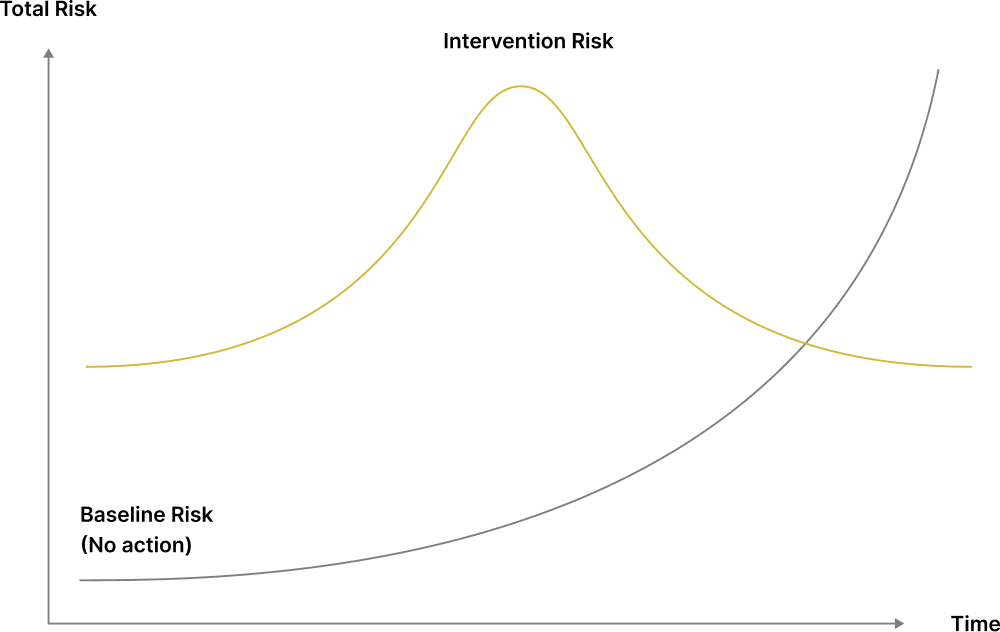
Baseline Risk Curve
Risk of the original problem if nothing is done.
Examples

This risk usually increases slowly over time.
Intervention Risk Curve
Risk Introduced by the preventive Action itself.
Examples
This risk Often spikes immediately when intervention occurs.
Optimal Intervention Zone
The rational decision point occurs where:
Baseline Risk > Intervention Risk
Before that point, intervention may increase total harm.
After that point, intervention may reduce total harm.
DIG Decision Output
DIG would present the decision like this:
| component | Example |
|---|---|
| Baseline risk | Probability + severity of problem |
| Intervention risk | Complication / disruption probability |
| Evidence level | High data / partial data / Knightian |
| Decision options | Intervene / delay / no action |
Why this is powerful for DU
This model applies across many domains
| Domain | Example |
|---|---|
| Medicine | Screening test surgery |
| Engineering | Safety system test |
| Finance | Fraud monitoring interventions |
| Infrastructure | Preventive maintenance |
| Cyber security | System penetration testing |
The Chernobyl safety test is an extreme example where:
Intervention risk > baseline risk under test conditions
Whether you’re exploring interoperability, dataset valuation, AI readiness, or ecosystem participation, we welcome conversations with researchers, organizations, and strategic partners interested in the future of structured data systems.
info@datauniversa.com