What It Actually Takes to
Build Global Ground-Truth Data
John F. Groom, Founder, DataUniversa
I've been traveling internationally for over 40 years, teaching English in Tokyo, distributing books in Eastern Europe after the fall of the Berlin Wall, running a publishing venture in Brazil, and producing fine arts and craft goods in Indonesia.
From March 2023 to May 2024, I traveled to 33 locations in 11 countries building Global Fast Fit. That system now feeds data into DataUniversa.
We now have a team of 25 people in 7 different countries around the world; US, China, Uganda, Kenya, Indonesia, Thailand, and India.
What we've learned is simple:
Collecting global data is not a software problem.
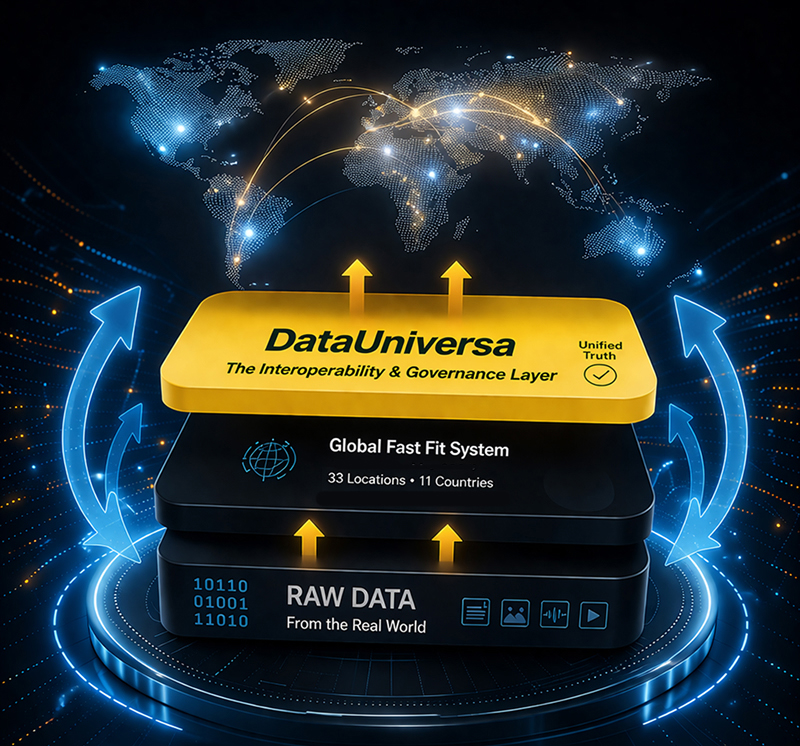
The Misconception
Most AI teams assume global data collection is just:

More users

More Uploads

More Scale
Once you operate globally, you are not dealing with a scaled version of the same system.
You are dealing with a different system entirely.
What It Actually Looks Like
Global data collection isn’t a scalable system it’s a fragmented, unpredictable reality shaped by different time zones, cultures, infrastructure, and constraints in every region.
Time Doesn’t Line Up
A 9AM call in the U.S. lands across the system like this, depending on if daylight savings time is in effect:
Location Local Time
Because there is no shared working day across regions, coordination becomes a constant operational challenge. Someone is always working late, someone else is just starting their day, and teams are rarely operating within the same active window. As a result, communication delays, scheduling friction, and coordination issues become part of normal day-to-day operations.
There Is No Shared Calendar
Across the countries we operate in, there are roughly:
Important Holidays:
- United States — Christmas, Thanksgiving
- Indonesia — Eid al-Fitr, Nyepi – when Bali completely shuts down for the day. In Bali, there are so many local festivals that even local Balinese may refuse to hire other Balinese because the work pattern is so disrupted.
- India — Diwali, Holi, Republic Day
- China — Lunar New Year, National Day Golden Week, Mid-Autumn Festival
- Thailand — Songkran, New Year, Loy Krathong
- Uganda — Easter, Uganda Martyrs’ Day
- Kenya — Jamhuri Day
You are not planning around a few known dates.
You are dealing with:
- Constant interruptions
- Shifting availability
- Unpredictable downtime
Communication Assumptions Break Immediately
In many places, email is not a reliable primary tool.
We’ve had to rely on:
- WhatsApp (dominant in many regions)
- Teams and Skype (best cross-country tools we’ve found)
- Text messaging
- In-person meetings
In-person remains the most reliable, that's why I spent 14 months traveling around the world recruiting the team.
That’s especially true for:
- Hiring
- Sensitive discussions
- Building trust
- Dealing with institutions
Getting a good connection for a call is something we take for granted in the US; you won't take it for granted once you have an operation in the Global South.
Language Is Not Binary
One example:
A Ugandan employee went to a government office and spoke English and was left to sit while other people were served. When she switched to the local language she was served immediately. But in many cases English is the expected language of the elites and government officials. It depends.
We only hire English speakers; but that means different things in different countries. Even at a high educational level, a husband and wife may speak English in very different ways. Accents can be charming, or really impede communication.
Culture Changes Execution
The “Just-get-it-done” start up culture works in the US; other places, not so much. A missing sense of urgency is what you will encounter most often. This is especially true with institutional responses. Over a year ago, we submitted a response to a RFP from the World Health Organization. We’re still waiting to hear back. In Kenya, we sponsored a young doctor on a research project that required ERB (Ethical Review Committee) approval. We heard round one and made changes. Over a year later, still haven’t had round two approval.
The default is not:
It is:
In many environments, you cannot assume:
- Urgency
- Independent initiative
- Problem-solving behavior
Instead, you often need:
- Explicit instructions
- Defined roles
- Repeated follow-up
Childcare and Educational Calendars
Many of our employees have children. School schedules are different in each location, and in many cases are not determined until very close to when school begins. In the Global South most education at any age requires payment of school fees, which is another issue. Help with childcare may or may not be available, depending on local factors.
Since many of our events work with schools, from primary to university, uncertain academic calendars need to be taken into account.
Transportation
How people and goods move locally and globally affects operations, often in highly unpredictable ways. During the 2026 conflict, when Iran launched missiles and drones toward Dubai and Qatar, the global air travel system was disrupted because major international flight networks rely heavily on airport hubs in those countries. As a result, a conflict primarily involving Iran, the United States, and Israel ended up affecting tourist travel to places like Bali, among many others.
But some things are predictable; car traffic just gets worse and worse in places like Bali, and no new roads are built. You’ll close your eyes when your taxi tries to cross a road in India in which there is no apparent opening. Our teams in Kenya and Uganda have been heroic in enduring long bus travel without complaint – which is good, as in many places old buses are still the only reliable transport available. Long ago I was in a small plane crash; but that was in the US; I wasn’t as scrared then as I was when traveling by small plane within Kenya. Almost without fail in the Global South the transportation infrastructure has not kept up with population growth.
In Bali, where I’ve spent significant time:
Operations are also affected by broader regional and global risks. Tourism-dependent economies can shift quickly during global disruptions, conflicts can impact transportation and air traffic worldwide, and some regions face ongoing risks such as terrorism, volcanic activity, or mandatory shutdowns like Nyepi in Bali.
These issues directly affect continuity, coordination, and daily operations.
Weather
It might be flooding in Sri Kalahasti when the sun is shining in Kampala and the snow is falling in Virginia. Global Fast Fit has done events in every location, and its important when planning events – most of ours have been outside – to taken into account local weather conditions. In places where infrastructure is lacking, which is most of the Global South, even simple rain can impact transportation.
Devices Are Not Standard
Many people:
In several regions, we have had to provide the operational infrastructure ourselves. Systems designed around assumptions like stable desktop workflows or reliable hardware often fail quickly in real-world environments where those conditions do not exist. To maintain continuity, we have purchased hardware, covered data plans, and in at least one case deployed a Starlink system simply to keep operations functioning consistently.
Infrastructure Is Not Fixable by Money
In Uganda especially, we’ve dealt with:
In practice, we have had to route operations through entirely different regions just to maintain continuity. Videos are sometimes downloaded in the U.S. or Bangkok and then transferred elsewhere because local infrastructure cannot reliably support the workflow. When you’re dealing with thousands of videos, and other large databases, this becomes a real issue as we move data around the world to accompany different logistical constraints.
Payment Systems Are a Constant Failure Point
This has been the most consistently difficult operational issue.
We’ve used:






International operations introduce constant financial and operational friction. Transfers can be delayed without warning, accounts may suddenly be flagged after crossing invisible thresholds, compliance reviews can escalate unexpectedly, and systems that worked reliably one day may stop functioning the next. At the same time, every payment must navigate local currency conversion, exchange rate spreads, and different banking infrastructures across countries.
Understanding the true cost of transactions, predicting whether payments will clear successfully, and knowing when funds will arrive become ongoing operational concerns rather than isolated issues.
Legal Systems Are Fragmented
Across regions:
In China specifically, business operations are heavily shaped by state influence and regulatory sensitivity. Many common platforms and tools are restricted, political considerations can directly affect operational decisions, and contractual agreements often function more as relationship frameworks than rigid legal guarantees.
As a result, organizations are not operating within a neutral or fully predictable legal environment, which introduces additional layers of uncertainty and operational complexity.
Trademark protection is fast and can be enforced in the UK and EU. In India, two and half years after application, still waiting for final resolution. In some places, trademark enforcement is a joke and is openly flouted; Indonesia stands out in this regard.
Corruption Is Part of Operating Reality
We’ve experienced:
Corruption affects:
- Timelines
- Costs
- Reliability
Elections and Politics
In 2024, shortly after our team was established in Kenya, a doctor leading a peaceful, permitted protest during a healthcare strike was shot in the head by soldiers. In both Kenya and Uganda, authorities have intentionally shut down or degraded internet quality during elections or periods of political instability, limiting communication and disrupting normal operations.
But elections are an issue everywhere. In India, the election process can take months rather than days, and systems often slow dramatically as organizations and institutions wait to see the results and determine who will hold decision-making authority. In many parts of the Global South, elections can signal major policy shifts, often more abruptly than in long-established Western democracies.
The following are actual messages:
- 5.19.2026; Kenya team manager: Hi John, we are experiencing some political instability. The riots began yesterday and they are continuing today. So we are being vigilant.
- 5.19.2026: Founder to team: Reminder; In times of political unrest our number one priority is to keep everyone safe; that includes team members, community center users, kids at Lisam, etc.
- 5.20.2026 – Kenya Team Manager; Hi John. The fighting parties came to an agreement yesterday at 2pm. All is back to normal
This is not at all unusual. In Kampala our team manager went out to get food for his family one night and had to retreat as soldiers were roaming the streets beating anyone they caught.
Safety and Basic Needs are not Guaranteed
Even with medical professionals on our team, access to reliable healthcare and basic services cannot be assumed across all regions. Medical availability varies significantly, response times are inconsistent, and quality of care can differ substantially depending on location. In some environments, even baseline conditions such as stable housing, food security, or dependable local services are not guaranteed, adding another layer of operational and human complexity to global coordination.
Bali, a Case Study
Even relatively developed and internationally connected parts of the Global South can experience repeated external shocks that materially disrupt business operations.
For example, Bali is often considered one of the easier places in the Global South to operate a tourism, hospitality, sourcing, or remote-work business. But over the last two decades alone:
Major Security Events
- 2002 — Bali bombings kill more than 200 people and severely disrupt tourism and international travel.
- 2005 — Second major bombing again impacts tourism and business confidence.
Global Economic Shocks
- 2008–2009 Great Recession — Global travel declines sharply, heavily impacting Bali’s tourism-dependent economy and local businesses.
Volcanic Disruptions
- 2017 — Mount Agung volcanic activity escalates. Bali’s international airport closes multiple times due to ash clouds. Hundreds of flights are canceled and tens of thousands of travelers are stranded.
- 2018 — Continued eruptions and ash disruptions intermittently affect aviation and tourism operations.
COVID-19
- March 2020 — International travel restrictions begin.
- 2020–2021 — Tourism effectively collapses. Many tourism workers return to villages in Java or back to agricultural work. Large parts of Bali become unusually quiet as hotels, restaurants, and businesses close or reduce operations.
- 2022 — Gradual tourism recovery begins as restrictions ease globally, although some international travel constraints remain.
Geopolitical Ripple Effects
- 2026 — Middle East conflict involving Iran contributes to broader global aviation and routing disruptions affecting travel into Asia, including Bali.
None of these events were specific to a single company. They were systemic shocks.
This is one reason why operating in the Global South often requires:
- operational redundancy
- distributed relationships
- flexible staffing
- tolerance for uncertainty
- and long-term resilience rather than short-term optimization
The lesson is not “avoid the Global South.”
The lesson is that real-world operations outside highly controlled environments are exposed to political, environmental, logistical, and macroeconomic forces that cannot always be predicted — even in relatively stable and internationally integrated locations like Bali.
Each of these issues is manageable on its own.
The problem is:
They all exist at the same time.
What This Means for Data
If you don’t account for:
 Incentives
Verification
Infrastructure
Language
Legal Context
Incentives
Verification
Infrastructure
Language
Legal Context
You don’t have reliable data. You have noise.
What We Built
We built for:
Unstable Infrastructure
Fragmented Systems
Real Human Behavior
That s what global ground-truth data actually requires.
The Real Question
The question is:
Global data will be required for the next generation of AI.
Whether you’re exploring interoperability, dataset valuation, AI readiness, or ecosystem participation, we welcome conversations with researchers, organizations, and strategic partners interested in the future of structured data systems.
info@datauniversa.com