Capacity Recovery
Assessment
Most artificial intelligence systems today are not limited by how much compute they have, but by how much of that compute actually produces usable output.
A meaningful portion of both machine resources and engineering time is spent on:
 Reconciling inconsistent data
Repeating the same transformations across pipelines
Executing workflows that do not produce usable results
Reworking outputs due to incomplete or misaligned inputs
Effective capacity is significantly lower than total capacity.
Reconciling inconsistent data
Repeating the same transformations across pipelines
Executing workflows that do not produce usable results
Reworking outputs due to incomplete or misaligned inputs
Effective capacity is significantly lower than total capacity.

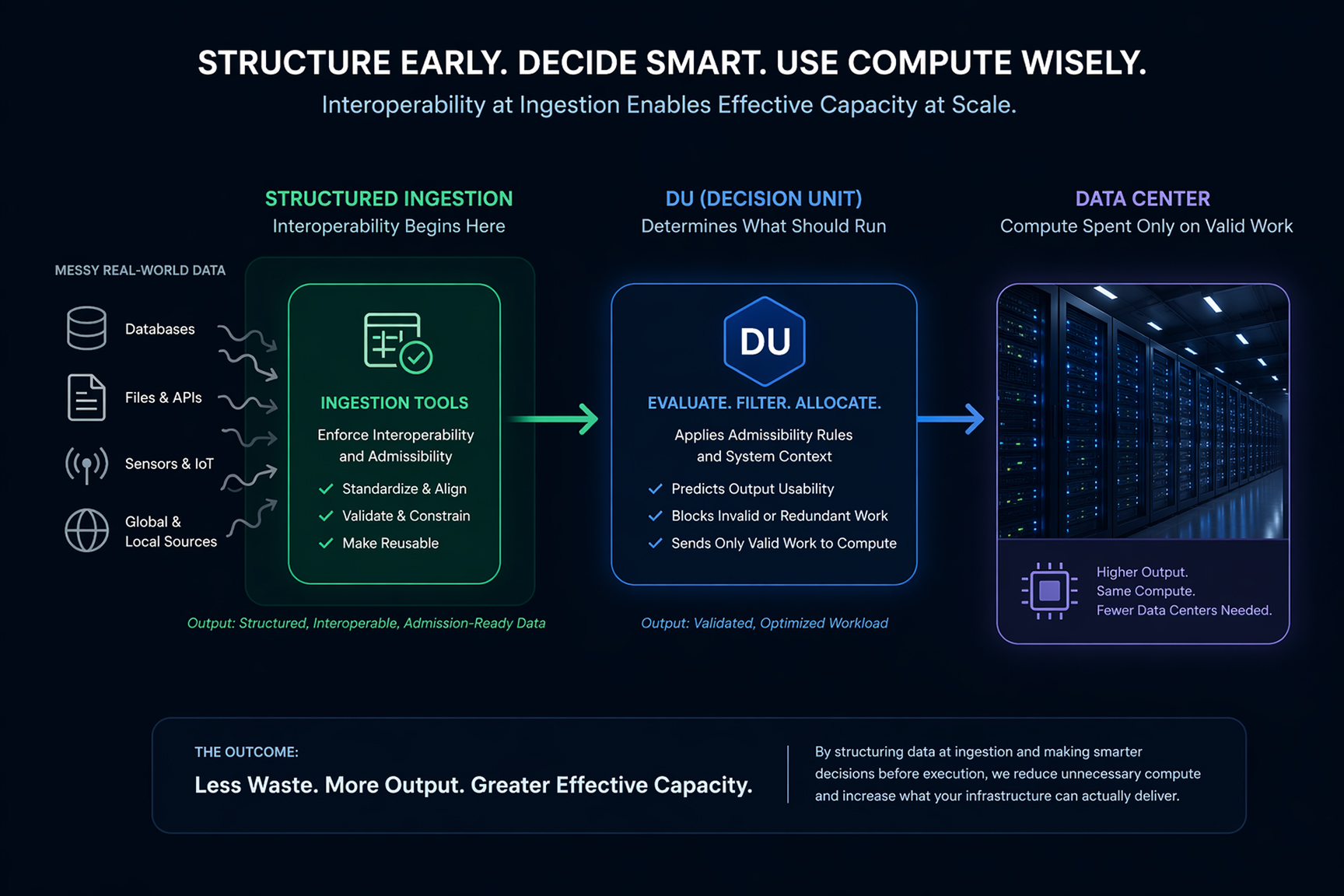

What DataUniversa Is
DataUniversa is not just an optimization tool it is a system that governs how data is structured, validated, and used.
It defines how datasets can be combined, what compute is allowed to run, and which outputs are admissible. At its core, it enforces interoperability, ensuring data can work across sources, and admissibility, ensuring only qualified data and outputs are used.
This makes it a credibility layer for the entire system.

Why This Matters
Interoperability isn’t just technical it changes system behavior.
It removes repeated transformations, reduces reconciliation work, prevents invalid executions, and increases reuse across workflows.
The immediate result is higher effective capacity, but more importantly, it enables better use of fragmented data, more reliable decision systems, faster deployment, and consistent evaluation across datasets.

Assessment Questions
You can quickly assess a data environment by looking at a few signals: how many sources you rely on and how consistent they are, how often transformations are needed, how much time is spent on cleanup, and how frequently workflows fail or need rework.
Also consider whether pipelines are reused or rebuilt, and what your main constraint is compute, engineering time, data usability, or deployment speed.

Sample Output
Estimated Recoverable Effective Capacity
30–45%
Why

Moderate to high data heterogeneity
Repeated transformation logic
Engineering time spent on reconciliation
Rate of reworked or invalid workflows
How This Happens (High-Level Mechanism)
We Reduce Waste At Multiple Stages.

Before execution
Prevent work that will not produce usable output

During transformation
Eliminate repeated data processing

At execution
Constrain compute to admissible data paths
Important Context
The exact gain varies.

Cleaner environments → lower gains

Fragmented, real-world data → higher gains
The Bigger Picture
Effective capacity is the first visible benefit. DataUniversa becomes the operating layer that governs how data, compute, and decisions interact.

Consistent cross-dataset evaluation
Scalable decision systems
Better use of real-world, messy data
Reduced dependency on bespoke pipelines
Whether you’re exploring interoperability, dataset valuation, AI readiness, or ecosystem participation, we welcome conversations with researchers, organizations, and strategic partners interested in the future of structured data systems.
info@datauniversa.com