Interoperability Is All You Need
Introducing the Missing Layer of AI
In 2017, Attention Is All You Need by Ashish Vaswani and colleagues introduced the Transformer architecture, replacing sequential models with attention mechanisms that process entire sequences instantly.
This enabled massive scaling and became the foundation of modern AI systems. We are building on that foundation, and are grateful for the work that made modern AI possible.
Since then, progress in AI has been driven primarily by two forces
But as models and compute have scaled, a different constraint has emerged:
Real-world data remains fragmented across systems, formats, environments, and conditions.

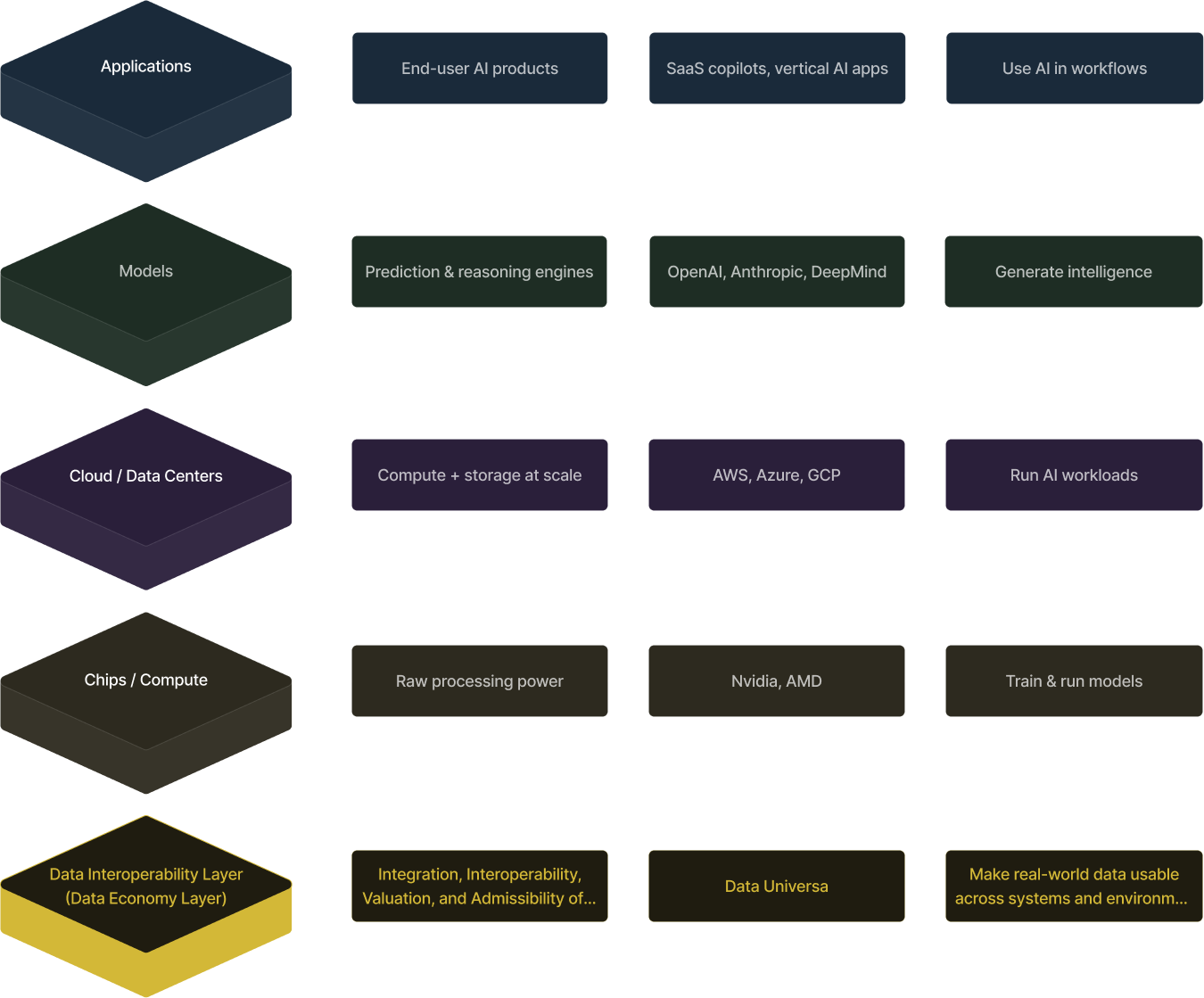
The AI Stack Is Missing a Layer
AI has solved intelligence. It has not solved data.
Modern AI has advanced rapidly driven by breakthroughs in models and massive increases in compute. But the remaining bottleneck is not intelligence. It is data. Data remains fragmented, unstructured, and disconnected across systems.
A New Data Economy
A new Ai-driven data economy will unlock entirely new forms of value creation-across individuals, small business, non profits, and Global enterprise.
Value is created by making data:
 Structured
Validated
Comparable
Usable Across Environments
Structured
Validated
Comparable
Usable Across Environments
Interoperability is what makes that Possible
Real-World Data, Structured
The following environment represents fundamentally disperese data from the Global South. All data shown here was captured in real-world conditions with team operating on the ground. This is not synthetic data. This is real data, structured into a common system.
One System. Seven Data Environments.
Below are seven disperse data collection environments that have been ingested via DataUniversa creating new analytical and operational value without requiring organizations to start data collection efforts from scratch.





-thumb.jpg)

THIS IS THE LAYER THAT MAKES DATA INTEROPERABLE
ENTER DATAUNIVERSA
Whether you’re exploring interoperability, dataset valuation, AI readiness, or ecosystem participation, we welcome conversations with researchers, organizations, and strategic partners interested in the future of structured data systems.
info@datauniversa.com