The Biggest Gains Often
Come From Reducing
Coordination Failure, Not
Improving Raw Capability
When people think about major advances in civilization, they usually imagine breakthroughs in raw capability: faster computers, stronger engines, better medicine, smarter AI models.
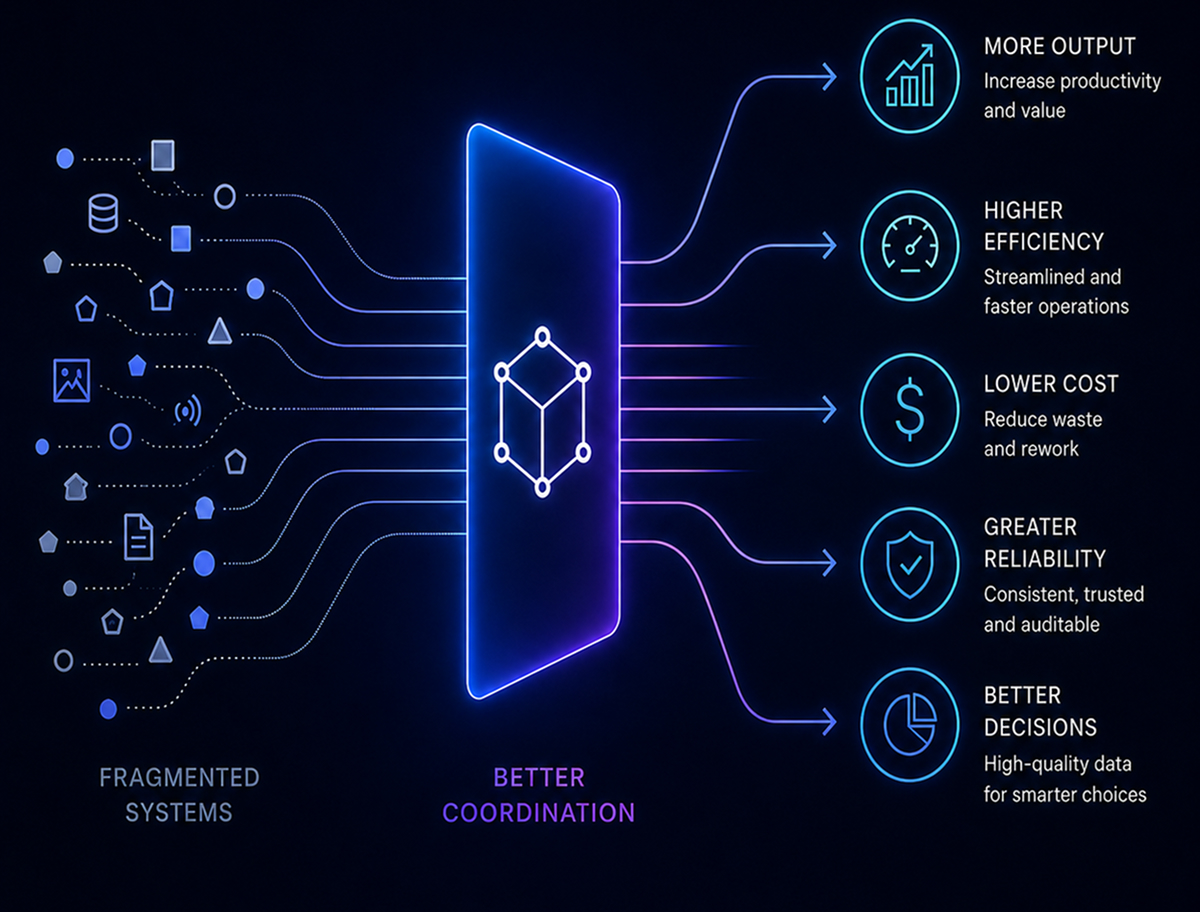
But some of the largest productivity gains in history came from something far less glamorous:
Reducing coordination failure.
In many cases, the core capability already existed. The breakthrough was not creating a more powerful engine, but allowing existing systems to work together more effectively with less waste, friction, ambiguity, and duplication.
This pattern appears repeatedly across history.
Sanitation Systems: The Human Body Was Already Powerful
Human biology did not fundamentally change in the last 100 years. The average person in a developed country is not genetically transformed compared to someone living in 1900.
Yet lifespan and healthspan improved dramatically.
Why?
Not primarily because we redesigned the human body. Instead, we reduced external failure modes:
- • Contaminated water
- • Sewage exposure
- • Infectious disease spread
- • Poor hygiene infrastructure
Sanitation systems, clean water infrastructure, and public health standards allowed the same underlying biological system to operate under far better conditions.
The result was enormous gains in effective human capacity.
Standard Shipping Containers: Global Trade Without Reinventing Ships
Before standardized shipping containers, global trade was slow, expensive, chaotic, and labor-intensive.
Cargo had to be individually handled at every port:
- • Unloaded manually
- • Repacked
- • Inspected repeatedly
- • Exposed to theft and damage
The key breakthrough was not dramatically better ships.
It was standardization.
The introduction of the standardized shipping container allowed ports, trucks, trains, and ships to coordinate around a common system.
This reduced:
- • Transfer friction
- • Handling time
- • Labor waste
- • Logistical uncertainty
The result was one of the largest increases in global economic efficiency in modern history.
Internet Protocols: The Internet's Real Superpower
The internet did not become transformative simply because computers became more powerful.
Its true breakthrough came from protocols:
- • TCP/IP
- • DNS
- • HTTP
Those standards allowed independent systems to communicate reliably across networks.
The result was not merely faster computers, but the creation of a globally interoperable information layer.
Without protocols, the internet would have remained fragmented and far less useful.
The Pattern
In each case:
- • The core capability already existed
- • The breakthrough came from reducing friction surrounding the system
This is a different kind of innovation.
Not: “make the engine infinitely better”
But: “allow the engine to operate with less waste and less coordination failure”
Historically, these coordination-layer improvements have often produced gains comparable to or greater than improvements in the core engine itself.
AI and the Modern Coordination Problem
One of the largest bottlenecks is not raw model capability. It is coordination failure surrounding data and systems.
Modern AI environments suffer from:
 Incompatible schemas
 Missing provenance
 Inconsistent definitions
 Duplicated cleaning work
 Failed integrations
 Unclear rights structures
 Unusable or inadmissible data
 Repeated manual reconciliation
Enormous amounts of compute, engineering time, and organizational effort are spent compensating for these failures.
This is where DataUniversa (DU) and the Global Model Intelligence Platform (GMIP) fit conceptually.
DataUniversa: Increasing Effective Capacity Through Coordination
The core thesis behind DU is not that AI models suddenly become intelligent through magic infrastructure.
This includes:
Interoperability At Ingestion
 chain-of-title systems
Standardized Metadata Structures
chain-of-title systems
Standardized Metadata Structures
 Cross-Dataset Compatibility
 Admissibility Controls
 Reduction Of Redundant Engineering Work
 Provenance Tracking
 Improved Recombination Potential
In this framework, AI systems are somewhat analogous to the human body before sanitation systems existed, or global trade before containerization. The underlying engine already exists. The real challenge is the surrounding environment those systems operate within. The goal is not simply to add more compute, but to reduce waste, ambiguity, and coordination failure so existing systems can operate more effectively. Sometimes the biggest breakthroughs are not entirely new engines, but better coordination systems built around the engines we already have.